THURSDAY-FRIDAY: 2.00-6.00PM SATURDAY- SUNDAY 3.00-7.00PM OR BY APPOINTMENT
Hans Op de Beeck
Danse Macabre
curated by Angel Moya Garcia
opening 11.4.2026, 11.00 AM-7.30PM
11.4.2026 – 25.10.2026
ph: Dominique Provost
Associazione Culturale Dello Scompiglio presents Hans Op de Beeck’s solo exhibition entitled Danse Macabre, curated by Angel Moya Garcia and open to the public from 11 April to 25 October 2026.
Hans Op de Beeck works across a wide variety of media and forms, steadily developing a versatile body of works that includes installations, sculptures, video works, texts, drawings, photography and watercolour paintings. For the past decade, Op de Beeck has also been active in theatre, opera, and contemporary dance as a playwright, stage director, scenographer, and costume designer. He is perhaps best known for his monumental, immersive, sensorial installations which are structured as enigmatic, fictional scenes frozen in time that visitors can walk through or sit within, evoking silent contemplation and moments of wonder. His distinctive body of work delves into the complex relationship between humans and the world around us, while also addressing universal questions about the invisible framework of being.
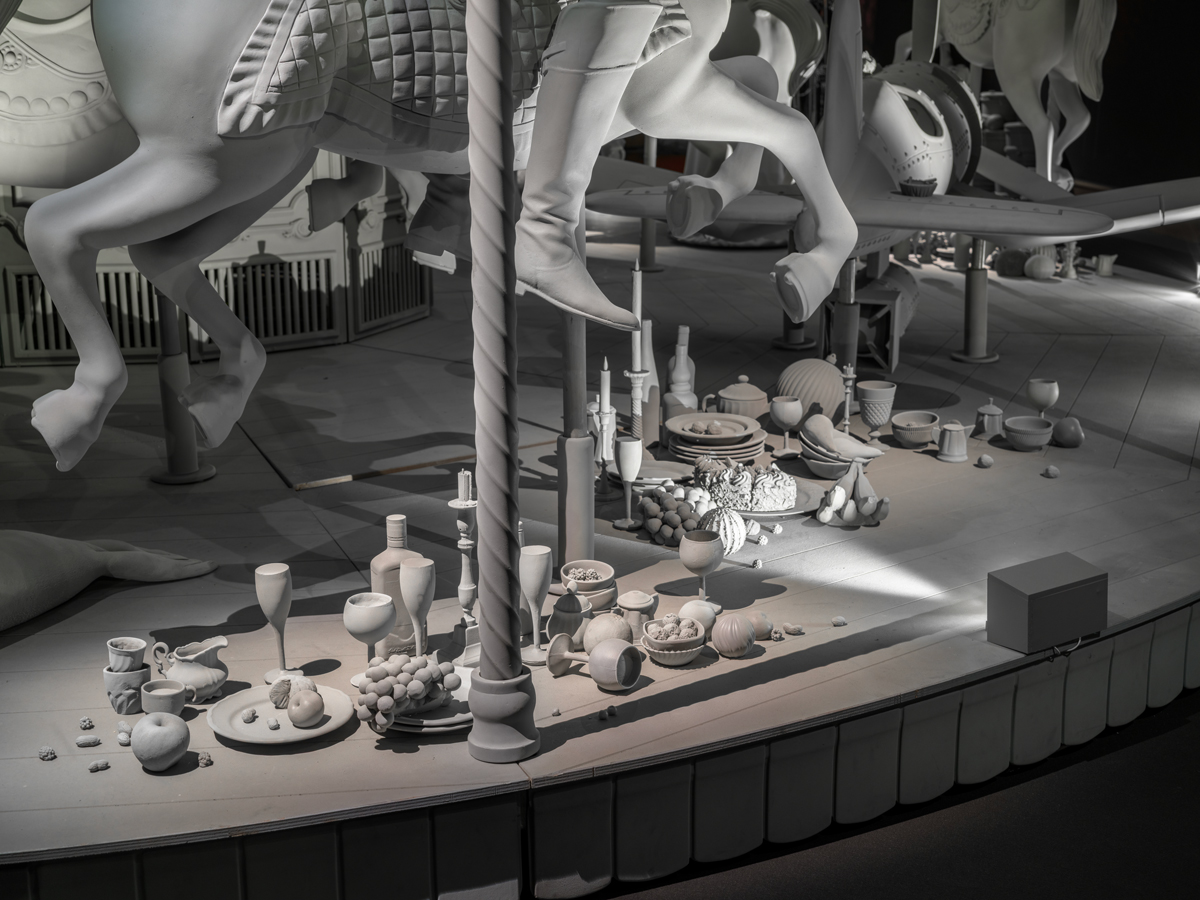
The exhibition at the Tenuta Dello Scompiglio unfolds through a site-specific installation and an animated film. The former, entitled Danse Macabre, appears as a black-and-white evocation of a nocturnal park composed of bare trees and puddles, where the path leads us to a life-size, monochrome grey afterimage of a carousel. This evocation of a fictional, colourless landscape acts as an accessible, cinematic and atmospheric “establishing shot” to potential stories in which oil drums smoulder with fire, the treetops stand stripped bare, and the winding path draws us toward the abandoned attraction, immersed in a night of absolute blackness.
The conventional carousel, as we still know it today in many variations, is usually a baroque, brightly coloured, glittering kitsch object that nostalgically evokes times gone by, when it still faced little competition from the noisy, crowded contemporary attractions. In 1999, at the beginning of his career, Op de Beeck created the video work “Blender”, in which a pompous, colourful carousel slowly begins to rotate and then magically dissolves into an unreadable, cotton candy-like swirling motion, only to come to a stop again. Since then, the carousel has been a recurring theme in his work, as a metaphor for the human condition. The artist considers the merry-go-round a quintessentially human, somewhat tragicomic form of entertainment and also a rather absurd object because we pick up our children, place them on wooden horses, and then let them spin aimlessly in circles.
Such amusement objects or constructions that are not, or no longer in use, acquire a melancholic undertone. The muted or vanished cheerfulness gives these objects, primarily intended to be moving, crowded, and colourful, a sombreness, like the sobering emptiness after a party. The grey monochrome colour gives the carousel a completely petrified, inert appearance, as if it were a fossil, frozen in time. By removing all colour, the carousel is stripped of its last layer of vibrancy, further distancing it from the actual object. This work is a sculptural interpretation, not an imitation. The matte grey colour both smothers as well as uplifts the image into something entirely else, like an ash-covered remnant after a major fire, or, for example, an orphaned object left behind after a nuclear disaster or war.
The title “Danse Macabre” refers to the stationary procession of carriages, horses, and objects that allude to death, which Op de Beeck designed as a kind of enlarged still life. The still life as an historical genre has a tradition of being a “memento mori”, a reminder of the transience and relativity of our lives. On the carousel, we encounter a whole family of skeletons, apparently enjoying themselves, piles of leftover plates, cake scraps, empty bottles and glasses, ashtrays, fruit and the like, which remind us of the battlefield of things left behind after a big party. Nothing is as it seems in this seemingly fossilized carousel, where a child's skeleton holds a roaring seal on a leash, a dandyish male skeleton calmly smokes a cigarette in a carriage, or where a toy airplane evokes a bomber from the First World War.
A musical soundscape, composed by Sam Vloemans and performed by the Hermes Ensemble (B), resonates from afar throughout the landscape, drawing us toward the second part, where the animated film Vanishing Point is screened, completing the exhibition. Its title, Vanishing Point, refers to a point in a picture plane of a perspective view where mutual parallel lines seem to converge. At the distance of a vanishing point, we can no longer perceive three-dimensional depth. Op de Beeck uses the term metaphorically, as a tipping point from which we shift from measurability and legibility into the unknown, indecipherable, and incomprehensible, or from the concrete to the abstract, mental to spiritual. The film starts with the image of a little boy resting peacefully on his back with his eyes closed. Next, we are transported to fictional landscapes, still lifes and figures. Together with the music, the watercolours are brought to life creating a sweeping, tranquil mood that invites one to briefly disappear into a moment of letting go.
Vanishing, on its own, means “disappearing suddenly and completely”, or, in mathematical terms, “becoming zero”. Op de Beeck is fascinated by the moments when, as human beings, we briefly become nothing or nobody — when we let us go out of our linguistic, logical, and rational understanding of the world and slip into a state of self-loss and timelessness.
2026_Op de Beeck_02
ph: Leonardo Morfini
2026_Op de Beeck
ph: Dominique Provost
Hans Op de Beeck has held substantial institutional solo exhibitions at various venues, including: GEM Museum of Contemporary Art, The Hague, The Netherlands (2004); MUHKA Museum of Contemporary Art, Antwerp, Belgium (2006); Centraal Museum, Utrecht, The Netherlands (2007); Towada Art Center, Japan (2008); Galleria Borghese, Rome, Italy (2009); The Smithsonian's Hirshhorn Museum and Sculpture Garden, Washington, USA (2010); Kunstmuseum Thun, Switzerland (2011); Centro de Arte Caja de Burgos, Spain (2011); Butler Gallery, Kilkenny, Ireland (2012); Kunstverein Hanover, Germany (2012); Tampa Museum of Art, USA (2013); Harn Museum of Art, Gainesville, USA (2013); FRAC Paca, Marseille, France (2013); MIT List Visual Arts Center, Cambridge, USA (2014); MOCA Cleveland, USA (2014); Sammlung Goetz, Munich, Germany (2014); Screen Space, Melbourne, Australia (2015); Le 104, Paris, France (2016); Kunstmuseum Wolfsburg, Germany (2017); Fondazione Pino Pascali, Polignano a Mare, Italy (2017); Kunstraum Dornbirn, Germany (2017); Museum Morsbroich, Leverkusen, Germany (2017); Scheepvaartmuseum, Amsterdam, The Netherlands (2018); Kunsthalle Krems, Krems an der Donau, Austria (2019); Amos Rex Museum, Helsinki, Finland (2022); The Nordic Watercolour Museum, Skärhamn, Sweden (2024), The Royal Museum of Fine Arts Antwerp, Antwerp, Belgium (2025).
Op de Beeck has participated in numerous group exhibitions at institutions including: Museo Reina Sofía, Madrid, Spain; Scottsdale Museum of Contemporary Art, Arizona, USA; ZKM, Karlsruhe, Germany; MACRO, Rome, Italy; Whitechapel Art Gallery, London, UK; MoMA PS1, New York, USA; Musée National d’Art Moderne, Centre Pompidou, Paris, France; Wallraf-Richartz Museum, Cologne, Germany; Hangar Bicocca, Milan, Italy; Hara Museum of Contemporary Art, Tokyo, Japan; 21C Museum, Louisville, Kentucky, USA; The Drawing Center, New York, USA; Kunsthalle Wien, Vienna, Austria; Shanghai Art Museum, Shanghai, China; MAMBA, Buenos Aires, Argentina; Haus der Kunst, Munich, Germany; Museo d’Arte Moderna di Bologna, Italy; Kunstmuseum Bonn, Germany; the State Hermitage Museum, St. Petersburg, Russia; Den Frie Center of Contemporary Art, Copenhagen, Denmark; Royal Museum of Fine Arts, Brussels, Belgium; Frankfurter Kunstverein, Frankfurt am Main, Germany; Museum Kunstpalast, Düsseldorf, Germany; Tate Modern, London, UK.
His work has been featured in prestigious art events such as the Venice Biennale, Italy; the Shanghai Biennale, China; the Aichi Triennale, Japan; the Singapore Biennale, Singapore; the Kochi-Muziris Biennale, India; Art Basel/ Art Unlimited, Basel, Switzerland; Setouchi Triennale, Shodoshima, Japan; Bruges Triennale, Belgium; the Lyon Biennale, France, and many other international art events.
Useful information
Opening: 11 April (11.00 am -7.30 pm) free admission
Opening hours: Thursday-Friday: 2.00-6.00PM, Saturday- Sunday 3.00-7.00 PM or by appointment: € 10,00
The ticket also includes admission to the permanent installations.
Info and reservations
SPE ticket office
Via di Vorno, 67 Vorno, Capannori (Lucca, Italy)
+39 (0)583 971125
This email address is being protected from spambots. You need JavaScript enabled to view it.
Associazione Culturale Dello Scompiglio Press Officer
Angelica D’Agliano
+39 339 8077411 +39 (0)583 971612
This email address is being protected from spambots. You need JavaScript enabled to view it.


